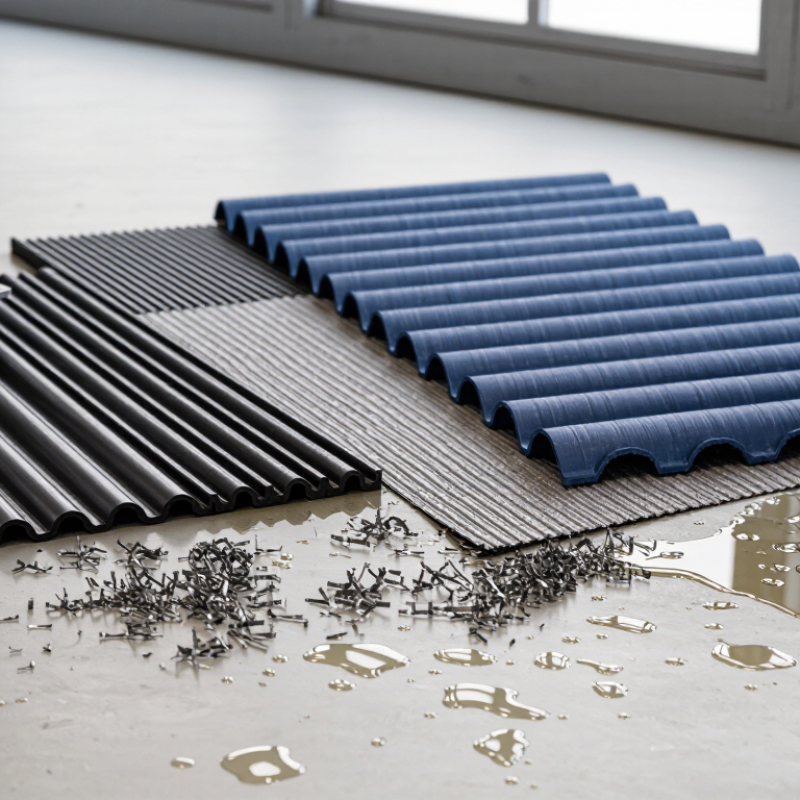
Choosing the right Corrugated Rubber Mat begins with more than comparing prices, colors, or surface patterns. It requires evidence about traction, resilience, drainage, comfort, and chemical exposure. A mat placed beside a machine may face oil, metal shavings, and constant foot traffic. A kitchen mat may face water, grease, and repeated cleaning. The details matter.
Market reports show why material selection deserves closer attention. Grand View Research identifies rubber flooring as a growing market, driven by commercial, industrial, and safety applications. However, market growth does not guarantee product quality. Reports from ASTM International and the International Organization for Standardization also emphasize testing, slip resistance, dimensional stability, and material performance. Buyers should verify test methods, not rely on vague claims such as “heavy duty.”
Rubber-material scientist Dr. Alan N. Gent explained a crucial principle: “The properties of rubber depend strongly on its formulation and temperature.” That observation applies directly to Corrugated Rubber Mat selection. A thick mat may still curl in cold conditions. A deep corrugation may trap debris instead of improving traction. Small details can create large maintenance problems.
This guide examines seven practical buying factors, including thickness, rib design, drainage, hardness, odor, cleaning needs, and installation conditions. It also questions common assumptions. More texture is not always better. Lower cost is not always economical. The best choice should match the floor, the hazard, and the people using it every day. Real performance begins with honest specifications and careful observation.
Choosing the Best Corrugated Rubber Mat: Start With Its Purpose
Understand the Purpose and Environment of the Corrugated Rubber Mat
A corrugated rubber mat should match the work area, not merely its floor color. Start by identifying the main risk: water, oil, loose debris, standing fatigue, or vehicle traffic. In wet entrances, raised channels can guide water away from footwear. In workshops, they can reduce contact with small spills and metal particles. The Occupational Safety and Health Administration requires walking surfaces to remain clean, orderly, and sanitary under 29 CFR 1910.22. A mat supports that duty, but it does not replace housekeeping.
The environment changes the specification. Outdoor mats need resistance to sunlight, rain, and temperature swings. Food-processing areas require surfaces that tolerate frequent washing and approved cleaning chemicals. Industrial zones may need thicker rubber and beveled edges for carts or forklifts. The National Institute for Occupational Safety and Health identifies slips, trips, and falls as persistent workplace hazards. OSHA also reports that falls remain a major source of serious workplace injuries. These findings make drainage, stability, and maintenance practical safety decisions.
Check the mat after installation. Does it curl near the doorway? Does oil soften its surface? Does the corrugation trap debris instead of releasing it? A practical mistake is choosing the deepest pattern without considering cleaning time. Deeper is not always better. Measure the floor, test drainage, and inspect the underside weekly during heavy use. One overlooked detail can matter. Even a well-designed mat becomes a hazard when it slides, ages, or hides contamination. (Sources: OSHA, Walking-Working Surfaces; NIOSH, workplace slip, trip, and fall prevention guidance.)
Temperature resistance is one of the key environmental factors when selecting a corrugated rubber mat. The chart shows typical continuous service-temperature ranges for common rubber compounds used in industrial matting. Actual performance depends on the formulation, thickness, chemicals, loading, and exposure time.
Selection tip: choose a compound whose temperature range covers the complete operating environment, then verify resistance to oils, chemicals, moisture, sunlight, and mechanical wear.
Material quality affects how a corrugated rubber mat performs under daily pressure. Look for dense rubber with consistent texture, clean edges, and no strong chemical odor. Recycled content can be useful, but ask for clear composition details. A trustworthy supplier should provide information about abrasion resistance, temperature limits, and intended use.
Check the mat’s flexibility by bending a corner gently. It should flex without cracking or leaving a permanent white mark. I once selected a cheaper mat because its surface looked identical. It hardened near a cold entrance within one season. That shortcut was wrong. Real performance matters more than appearance.
Thickness should match the environment. A thin mat may suit a dry walkway, while a thicker design offers better cushioning and floor protection. However, extra thickness can create a trip edge or interfere with doors. Measure the clearance carefully.
Surface design deserves equal attention. Raised ribs can guide water and dirt away from footwear, while deeper corrugation may improve traction in wet areas. Press the mat against the floor and check for movement. Too smooth can be unsafe. Too aggressive can be uncomfortable and difficult to clean. Test a sample after use, not only when new. That small review often reveals what specifications miss.
Tip 1: Measure the installation area before shopping. Record both length and width, including corners, doorways, and exposed edges. A mat that is too small leaves dangerous gaps.
Tip 2: Match the shape to the floor. Rectangular mats suit workbenches and corridors, while custom-cut sections fit around posts or equipment. Measure twice. Odd corners are easy to miss. Tip 3: Plan coverage around movement, not just furniture. A standing mat should extend beyond the worker’s usual foot position. For carts, cover the entire turning path. A few uncovered inches can collect water and dirt.
Tip 4: Check the mat’s thickness against nearby thresholds and doors. Thick corrugated rubber can improve comfort, but it may block a door or create a raised edge. I have seen this mistake during installation. Tip 5: Connect multiple mats carefully when one piece cannot cover the area. Align the corrugations and keep seams flat. Uneven joins may catch shoes or wheels. Tip 6: Leave enough clearance for cleaning. A tightly fitted mat can trap moisture beneath it, especially near entrances. Lift it regularly and inspect the floor underneath. Tip 7: Consider future changes. A slightly larger layout may work better if shelves, benches, or equipment move later. Still, oversized mats can become awkward to handle. The best choice balances coverage, stability, and practical maintenance.
7 Tips for Choosing the Best Corrugated Rubber Mat
Compare Safety, Comfort, Durability, and Maintenance Features
Start with safety. Choose raised corrugations that channel water away from walking areas. Test the mat with wet shoes, not only dry hands. Check its slip-resistance data and edge stability. A curled corner can create a serious trip hazard. Measure the doorway carefully. Oversized mats may buckle against walls or equipment.
Comfort matters during long standing periods. Look for resilient rubber that cushions heels without feeling unstable. In a workshop, kneel briefly on the mat before buying it. That small test reveals more than a product description. Consider thickness, surface texture, and drainage holes. Softer is not always better. Excessive cushioning may make carts harder to push.
Durability depends on traffic, temperature, oils, and sharp debris. Request material information and confirm chemical compatibility for your workplace. Inspect the corrugations for early flattening after regular use. Maintenance should remain practical. A mat that lifts easily makes sweeping faster. Rinse it, scrub trapped grit, and let both sides dry fully. I once chose a heavy mat that stayed damp underneath. It lasted, but cleaning became frustrating. No mat is perfect. Recheck its position each week, especially near entrances. Replace it when cracks, brittle edges, or permanent flattening appear. Reliable selection combines testable safety, daily comfort, proven wear resistance, and manageable care.
7 Tips for Choosing the Best Corrugated Rubber Mat
Check Installation Needs, Costs, and Product Specifications
A good corrugated rubber mat should match the floor, traffic, and working conditions. Measure the area carefully, including door swings and awkward corners. Concrete must be clean, dry, and reasonably level before installation. Dust under the mat can create bumps and shorten its service life. Decide whether loose laying is enough or whether adhesive, edge trims, or joined sections are necessary. I once underestimated seam movement near a loading entrance. The mat shifted more than expected.
Review the technical sheet before comparing prices. Check thickness, roll width, rib height, weight, hardness, and temperature limits. Confirm resistance to oils, water, cleaning chemicals, and repeated impact. A thicker mat is not always better. It may become difficult to cut, move, or fit beneath doors. Ask for slip-resistance data and dimensional tolerances. Those details often reveal quality better than photographs. Request a sample and test it under real footwear, carts, and moisture.
Calculate the installed cost, not only the purchase price. Include delivery, cutting, floor preparation, adhesive, labor, and future replacement. A low-cost mat may require frequent cleaning or develop curled edges. That becomes expensive quickly. Compare warranty terms with realistic site conditions. Also consider maintenance access. If workers must lift heavy rolls for cleaning, the chosen design may be impractical. Recheck every assumption before ordering. Small mistakes become permanent once the mat is cut.
| Tip | Selection Area | Key Metric | Typical Data or Range | Practical Recommendation |
|---|---|---|---|---|
| 1 | Match the Mat to the Installation Area | Intended location and exposure | Indoor workshops, garages, service areas, loading zones, walkways, and covered outdoor spaces | Choose a product rated for the actual environment. For outdoor or damp areas, select rubber with moisture resistance and provide drainage beneath the mat. |
| 2 | Choose the Correct Thickness | Rubber thickness | Common options: 3 mm, 5 mm, 6 mm, 8 mm, and 10 mm; heavy-duty applications commonly use 8–10 mm | Use 3–5 mm for light-duty protection and general walkways. Select 6–10 mm where impact absorption, floor protection, or extended service life is important. |
| 3 | Evaluate Corrugation and Surface Grip | Surface profile and slip resistance | Raised ribs or corrugations typically range from approximately 1–3 mm in profile height; wet traction depends on pattern and flooring conditions | Use a deeper, well-spaced pattern where water, oil, or debris may be present. Confirm that the underside also provides adequate floor contact and stability. |
| 4 | Check Material and Temperature Requirements | Rubber composition and operating temperature | General-purpose rubber mats are often suitable for approximately −20°C to 80°C; specialty compounds may support wider ranges | For ordinary industrial or commercial floors, general-purpose rubber is usually sufficient. For high heat, chemical contact, or prolonged sunlight, verify the supplier’s compound and temperature data. |
| 5 | Plan the Installation Method | Cutting, joining, edging, and fixing | Typical installation uses loose laying, adhesive bonding, double-sided tape, or mechanical edging; allow approximately 3–5% extra material for cutting | Measure the floor in a simple layout before ordering. Keep seams away from heavy traffic when possible, trim edges accurately, and use ramps or beveled edging to reduce trip hazards. |
| 6 | Compare Total Installed Cost | Material and installation cost | Indicative material cost: about US$2–10 per square foot, depending on thickness, compound, finish, and order size; installation may add roughly US$1–4 per square foot | Compare the complete cost, including freight, cutting waste, adhesive, edging, labor, and future replacement. A thicker mat may cost more initially but reduce replacement frequency. |
| 7 | Review Product Specifications and Maintenance | Size, weight, cleaning, and service life | Common roll widths: 1–2 m; roll lengths often 5–10 m or custom; a 5 mm rubber mat may weigh approximately 5–7 kg per square meter | Confirm roll dimensions, dimensional tolerance, backing type, odor level, warranty terms, and cleaning instructions. Select a design that can be lifted or cleaned without specialized equipment. |