Global buyers comparing top Rubber Roll manufacturers in China need more than a competitive quotation. A roll may look flawless in a catalog yet perform poorly under heat, pressure, or repeated cleaning. Details matter. Buyers should compare compound options, hardness tolerances, surface finish, bonding quality, runout control, and balancing standards. Ask for technical drawings, inspection records, sample rolls, and clear batch-traceability information. Test the fit.
Rubber technologist Dr. Sadhan K. De’s published work offers a useful technical lens. The following is an editorial paraphrase, not a verbatim quotation: “Specify the roll for its actual service conditions, not merely its catalog description.” That principle applies across printing, paper, textile, and steel-processing lines. A small difference in cover hardness or surface texture can affect grip, finish, wear, and downtime.
This guide examines Chinese manufacturers through practical buying criteria: product range, customization, quality controls, communication, lead times, and export support. It also considers what buyers should verify before placing an order, including test methods and the scope of any stated certifications. A supplier’s polished brochure is useful, but it is not proof. Request evidence, compare like with like, and confirm critical specifications in writing. Even careful checks cannot remove every risk. They can make the decision clearer.
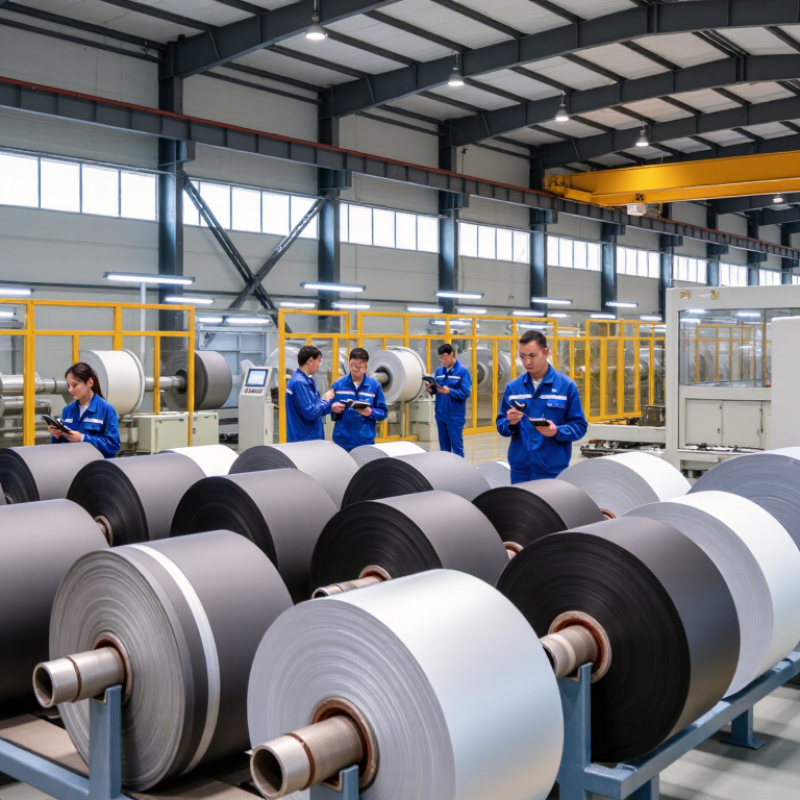
Rubber rolls are cylindrical components that transfer pressure, grip, or motion across a working surface. Their design depends on the job. Covering rolls help guide paper, film, and fabric, while feed rolls pull sheets through machinery. Printing and laminating lines often need a smooth, even surface. A textured finish can improve grip. Small details matter.
Common covering materials include natural rubber, nitrile, EPDM, silicone, and polyurethane. Natural rubber offers flexibility and traction, while nitrile is often chosen for resistance to oils. EPDM performs well in outdoor settings, and silicone can suit processes involving heat. Polyurethane is valued for abrasion resistance and load-bearing ability. These are general tendencies, not guarantees; compound formulation and operating conditions can change performance.
For industrial buyers, hardness, diameter, face length, runout, and surface finish deserve attention. A roll that looks suitable on a drawing may still vibrate or wear unevenly under real loads. Ask manufacturers for material data, tolerance details, and sample inspection records. Also describe the substances, temperature range, speed, and pressure the roll will encounter. Paper mills, packaging lines, textile plants, and metal processing equipment each place different demands on the cover. There is no universal “best” compound. Sometimes the specification is the weak link.

When evaluating rubber roll manufacturers in China, begin with the process, not the brochure. Ask how they control compound mixing, curing temperature, hardness, and runout. Request recent inspection records for a roll similar to yours. A smooth sample matters, but so does a repeatable result across a full production batch.
Material markets affect cost and lead time. The International Rubber Study Group’s 2024 outlook projected global rubber demand at about 15.7 million tonnes, highlighting the scale of demand pressure on supply chains. Ask suppliers to identify rubber grades, steel-core sources, and how they handle price changes. ISO 9001 certification can support confidence in quality systems, but it does not certify a roll’s performance. Still, paperwork can mislead.
Use a drawing to check dimensions, tolerances, bonding, and surface finish. Then ask for test methods, acceptance limits, and traceability from raw compound to finished roll. A capable factory should explain what happens when hardness falls outside specification. Request a trial order and inspect the roll under your actual operating conditions. One detail is often missed: agree on packaging that protects the surface during shipping, and confirm replacement-part lead times in writing.
China’s rubber roll manufacturers serve industries such as paper, printing, textiles, and metal processing. Their product profiles often include standard and custom rolls, with options for different hardness levels, diameters, and working surfaces. A buyer should look beyond a broad product list. Ask how the maker measures runout, checks rubber thickness, and verifies bonding between the core and covering. Details matter.
Leading manufacturers typically describe their capabilities through materials, machining, and quality-control processes. Some specialize in abrasion-resistant coverings for demanding production lines; others focus on precise finishing for smooth sheet handling. Useful evidence includes material data sheets, inspection records, and clear tolerance ranges. Factory photos can help, but they do not replace a technical conversation or a sample review. Not always.
A reliable supplier profile also explains how the company handles drawings, trial orders, and after-sales questions. Share operating speed, temperature, media, and contact pressure before requesting a quotation. These conditions affect service life, yet they are sometimes missing from early discussions. That gap can lead to avoidable rework. Buyers should compare documented test methods and response quality, not just price or stated production capacity. A careful comparison takes time.
For global buyers, a rubber roll supplier’s real strength lies in repeatable process control, not a polished factory tour. A capable plant tracks compound recipes, roll-core preparation, bonding, curing, and final grinding. Technicians should record batch numbers and test hardness, runout, and surface finish. During inspection, a dial gauge checks whether the roll runs true; a durometer measures rubber hardness. Small variations matter. Yet laboratory readings alone cannot predict service life under every load, speed, or chemical exposure.
The ISO Survey of Management System Standard Certifications 2022 counted 1,265,216 valid ISO 9001 certificates worldwide. This shows how widely quality systems are used, but it does not certify a particular roll’s performance.
Buyers should verify certificate scope and validity, then request inspection records and test results for the actual product. A certificate helps. It is not proof of durability.
Ask how the supplier handles rejected batches, calibration, and corrective actions. One point deserves reflection: buyers sometimes compare hardness figures without confirming the test method or sampling location. Clear specifications and witnessed tests can prevent that mismatch.
Sourcing rubber rolls in China works best when buyers define the operating conditions before comparing quotations. Share the roll’s diameter, face length, core material, hardness range, surface finish, and expected line speed. Include the chemicals, heat, pressure, and cleaning agents it will encounter. Small details matter. A roll used for paper converting may need different compounds and tolerances from one used in printing or textile production.
Customization should be confirmed with measurable specifications, not phrases like “high quality.” Ask how hardness is tested, how runout is checked, and whether the supplier can provide a drawing for approval. Request a sample or a trial roll when the application is critical. Inspect it under real working conditions if possible. A polished sample is useful, but it cannot prove long-term performance. That distinction is easy to overlook.
For export, agree on packaging, delivery terms, production lead time, and the documents required at the destination before placing an order. Ask for protective end caps and moisture-resistant wrapping, especially for long-distance shipment. Confirm that labels match the purchase order and that spare parts can be identified later. Keep written records of approved dimensions and material changes. Even a careful process can miss something; a final checklist helps, though it is not a substitute for clear communication.
| Evaluation Area | Common Options or Requirements | What Global Buyers Should Confirm | Useful Sourcing Evidence |
|---|---|---|---|
| Roll application | Printing, paper processing, textile processing, material handling, or industrial use | Whether the proposed roll is designed for the actual substrate, operating environment, and machine duty | Application description, machine details, operating conditions, and reference drawings |
| Rubber compound | Compound selection depends on factors such as abrasion, oils, chemicals, temperature, and contact material | Compatibility with the process and any specified resistance, hardness, or regulatory requirements | Compound data sheet, test results where applicable, and written confirmation of the agreed specification |
| Dimensions and tolerances | Core diameter, overall diameter, face length, shaft details, and runout requirements are typically specified by the buyer | The supplier’s ability to manufacture to the drawing and measure critical dimensions consistently | Approved drawing, tolerance schedule, inspection method, and sample inspection report |
| Surface finish and profile | Smooth, ground, grooved, crowned, or other specified profiles, depending on the process | Required surface texture, profile geometry, and finish measurement or acceptance criteria | Surface specification, drawing or sample, and pre-shipment inspection records |
| Customization and tooling | Custom dimensions, shaft configurations, grooves, coverings, and packaging may be available subject to equipment and order requirements | Minimum order quantity, tooling charges, prototype process, design ownership, and change-control procedure | Written quotation, approved technical specification, sample approval, and documented revision history |
| Quality control | Inspection can cover dimensions, hardness, appearance, balance, runout, and other agreed characteristics | Which checks are performed, how acceptance is defined, and how nonconforming products are handled | Quality plan, inspection records, corrective-action process, and any relevant management-system certificates for verification |
| Lead time and order planning | Production timing varies with design approval, material availability, order quantity, and customization | Whether the quoted schedule includes sample approval, production, inspection, and dispatch preparation | Order schedule, milestone dates, capacity confirmation, and agreed procedures for schedule changes |
| Export packaging | Packaging should protect the roll and its machined surfaces during handling and transport; requirements depend on size and route | Protection against impact, moisture, contamination, and movement, plus any destination-specific packing requirements | Packaging specification, shipment photos, package dimensions, and weight details |
| Export documentation | Commercial invoice, packing list, and transport documents are commonly involved; additional documents depend on the shipment and destination | Correct product description, quantities, weights, consignee details, delivery terms, and destination import requirements | Draft documents for buyer review and confirmation of the responsible party for each required document |
| Trade terms and logistics | Incoterms® rules allocate specified delivery obligations, costs, and risks between seller and buyer | Named place or port, applicable Incoterms® rule and version, freight arrangements, and cargo insurance responsibilities | Purchase contract or quotation stating the rule, version, and precise named place |
| Warranty and after-sales support | Coverage and remedies are contract-specific and may depend on the agreed product specification and operating conditions | Warranty period, exclusions, claim evidence, response time, and responsibility for replacement or repair logistics | Written warranty terms, claim procedure, and agreed technical support channel |